


How Turbos Work (Required Reading)!


Thread Starter
|
4th Gear
Joined: Jul 2006
Posts: 3,716
From: New York
 How Turbos Work (Required Reading)!
Seeing as we all have turbocharged cars, and there a quite a few new members... I found this to be extremely important and a MUST READ!
Especially if you plan on modifying your car.
Please take the time to read through this article from howstuffworks.com in it's entirety.
How Turbochargers Work
by Karim Nice
When people talk about race cars or high-performance sports cars, the topic of turbochargers usually comes up. Turbochargers also appear on large diesel engines.
A turbo can significantly boost an engine's horsepower without significantly increasing its weight, which is the huge benefit that makes turbos so popular!
In this article, we'll learn how a turbocharger increases the power output of an engine while surviving extreme operating conditions. We'll also learn how wastegates, ceramic turbine blades and ball bearings help turbochargers do their job even better.
Turbochargers are a type of forced induction system. They compress the air flowing into the engine (see How Car Engines Work for a description of airflow in a normal engine). The advantage of compressing the air is that it lets the engine squeeze more air into a cylinder, and more air means that more fuel can be added. Therefore, you get more power from each explosion in each cylinder. A turbocharged engine produces more power overall than the same engine without the charging. This can significantly improve the power-to-weight ratio for the engine (see How Horsepower Works for details).
In order to achieve this boost, the turbocharger uses the exhaust flow from the engine to spin a turbine, which in turn spins an air pump. The turbine in the turbocharger spins at speeds of up to 150,000 rotations per minute (rpm) -- that's about 30 times faster than most car engines can go. And since it is hooked up to the exhaust, the temperatures in the turbine are also very high.
The Basics
One of the surest ways to get more power out of an engine is to increase the amount of air and fuel that it can burn. One way to do this is to add cylinders or make the current cylinders bigger. Sometimes these changes may not be feasible -- a turbo can be a simpler, more compact way to add power, especially for an aftermarket accessory.
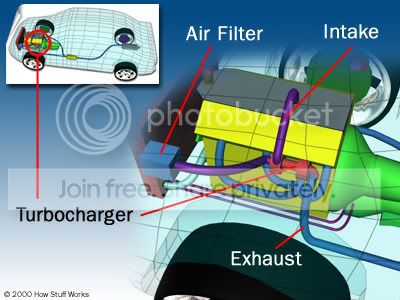
Where the turbocharger is located in the car.
Turbochargers allow an engine to burn more fuel and air by packing more into the existing cylinders. The typical boost provided by a turbocharger is 6 to 8 pounds per square inch (psi). Since normal atmospheric pressure is 14.7 psi at sea level, you can see that you are getting about 50 percent more air into the engine. Therefore, you would expect to get 50 percent more power. It's not perfectly efficient, so you might get a 30- to 40-percent improvement instead.
One cause of the inefficiency comes from the fact that the power to spin the turbine is not free. Having a turbine in the exhaust flow increases the restriction in the exhaust. This means that on the exhaust stroke, the engine has to push against a higher back-pressure. This subtracts a little bit of power from the cylinders that are firing at the same time.
Inside a Turbocharger
The turbocharger is bolted to the exhaust manifold of the engine. The exhaust from the cylinders spins the turbine, which works like a gas turbine engine. The turbine is connected by a shaft to the compressor, which is located between the air filter and the intake manifold. The compressor pressurizes the air going into the pistons.
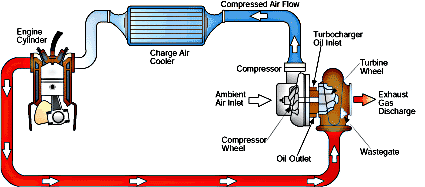
Image courtesy Garrett How a turbocharger is plumbed in a car
The exhaust from the cylinders passes through the turbine blades, causing the turbine to spin. The more exhaust that goes through the blades, the faster they spin.
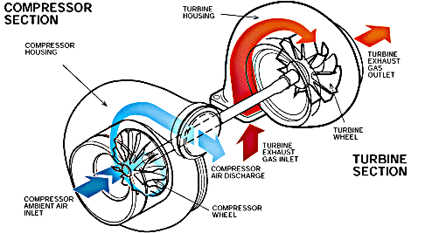
Image courtesy Garrett Inside a turbocharger
On the other end of the shaft that the turbine is attached to, the compressor pumps air into the cylinders. The compressor is a type of centrifugal pump -- it draws air in at the center of its blades and flings it outward as it spins.
Photo courtesy Garrett
Turbo compressor bladesIn order to handle speeds of up to 150,000 rpm, the turbine shaft has to be supported very carefully. Most bearings would explode at speeds like this, so most turbochargers use a fluid bearing. This type of bearing supports the shaft on a thin layer of oil that is constantly pumped around the shaft. This serves two purposes: It cools the shaft and some of the other turbocharger parts, and it allows the shaft to spin without much friction.
There are many tradeoffs involved in designing a turbocharger for an engine. In the next section, we'll look at some of these compromises and see how they affect performance.
Design Considerations
One of the main problems with turbochargers is that they do not provide an immediate power boost when you step on the gas. It takes a second for the turbine to get up to speed before boost is produced. This results in a feeling of lag when you step on the gas, and then the car lunges ahead when the turbo gets moving.
One way to decrease turbo lag is to reduce the inertia of the rotating parts, mainly by reducing their weight. This allows the turbine and compressor to accelerate quickly, and start providing boost earlier. One sure way to reduce the inertia of the turbine and compressor is to make the turbocharger smaller. A small turbocharger will provide boost more quickly and at lower engine speeds, but may not be able to provide much boost at higher engine speeds when a really large volume of air is going into the engine. It is also in danger of spinning too quickly at higher engine speeds, when lots of exhaust is passing through the turbine.
A large turbocharger can provide lots of boost at high engine speeds, but may have bad turbo lag because of how long it takes to accelerate its heavier turbine and compressor. Luckily, there are some tricks used to overcome these challenges.
Most automotive turbochargers have a wastegate, which allows the use of a smaller turbocharger to reduce lag while preventing it from spinning too quickly at high engine speeds. The wastegate is a valve that allows the exhaust to bypass the turbine blades. The wastegate senses the boost pressure. If the pressure gets too high, it could be an indicator that the turbine is spinning too quickly, so the wastegate bypasses some of the exhaust around the turbine blades, allowing the blades to slow down.
Some turbochargers use ball bearings instead of fluid bearings to support the turbine shaft. But these are not your regular ball bearings -- they are super-precise bearings made of advanced materials to handle the speeds and temperatures of the turbocharger. They allow the turbine shaft to spin with less friction than the fluid bearings used in most turbochargers. They also allow a slightly smaller, lighter shaft to be used. This helps the turbocharger accelerate more quickly, further reducing turbo lag.
Ceramic turbine blades are lighter than the steel blades used in most turbochargers. Again, this allows the turbine to spin up to speed faster, which reduces turbo lag.
Some engines use two turbochargers of different sizes. The smaller one spins up to speed very quickly, reducing lag, while the bigger one takes over at higher engine speeds to provide more boost.
When air is compressed, it heats up; and when air heats up, it expands. So some of the pressure increase from a turbocharger is the result of heating the air before it goes into the engine. In order to increase the power of the engine, the goal is to get more air molecules into the cylinder, not necessarily more air pressure.
Image courtesy Garrett How a turbocharger is plumbed (including the charge air cooler)
An intercooler or charge air cooler is an additional component that looks something like a radiator, except air passes through the inside as well as the outside of the intercooler. The intake air passes through sealed passageways inside the cooler, while cooler air from outside is blown across fins by the engine cooling fan.
The intercooler further increases the power of the engine by cooling the pressurized air coming out of the compressor before it goes into the engine. This means that if the turbocharger is operating at a boost of 7 psi, the intercooled system will put in 7 psi of cooler air, which is denser and contains more air molecules than warmer air.
A turbocharger helps at high altitudes, where the air is less dense. Normal engines will experience reduced power at high altitudes because for each stroke of the piston, the engine will get a smaller mass of air. A turbocharged engine may also have reduced power, but the reduction will be less dramatic because the thinner air is easier for the turbocharger to pump.
Older cars with carburetors automatically increase the fuel rate to match the increased airflow going into the cylinders. Modern cars with fuel injection will also do this to a point. The fuel-injection system relies on oxygen sensors in the exhaust to determine if the air-to-fuel ratio is correct, so these systems will automatically increase the fuel flow if a turbo is added.
If a turbocharger with too much boost is added to a fuel-injected car, the system may not provide enough fuel -- either the software programmed into the controller will not allow it, or the pump and injectors are not capable of supplying it. In this case, other modifications will have to be made to get the maximum benefit from the turbocharger.
Lots More Information
Related HowStuffWorks Articles
How Car Engines Work
How Automobile Ignition Systems Work
How Horsepower Works
How Torque Converters Work
How Champ Cars Work
How NASCAR Race Cars Work
How Car Cooling Systems Work
How does nitrous oxide help an engine perform better?
More Great Links
Turbo International: How Turbos Work - illustrated!
Mercedes-Benz: VNT turbocharger with variable turbine geometry
Ray Hall Turbocharging - Twin Turbo 351 Windsor
Sport Compact Car Magazine: Turbo Basics
Especially if you plan on modifying your car.
Please take the time to read through this article from howstuffworks.com in it's entirety.
How Turbochargers Work
by Karim Nice
When people talk about race cars or high-performance sports cars, the topic of turbochargers usually comes up. Turbochargers also appear on large diesel engines.
A turbo can significantly boost an engine's horsepower without significantly increasing its weight, which is the huge benefit that makes turbos so popular!
In this article, we'll learn how a turbocharger increases the power output of an engine while surviving extreme operating conditions. We'll also learn how wastegates, ceramic turbine blades and ball bearings help turbochargers do their job even better.
Turbochargers are a type of forced induction system. They compress the air flowing into the engine (see How Car Engines Work for a description of airflow in a normal engine). The advantage of compressing the air is that it lets the engine squeeze more air into a cylinder, and more air means that more fuel can be added. Therefore, you get more power from each explosion in each cylinder. A turbocharged engine produces more power overall than the same engine without the charging. This can significantly improve the power-to-weight ratio for the engine (see How Horsepower Works for details).
In order to achieve this boost, the turbocharger uses the exhaust flow from the engine to spin a turbine, which in turn spins an air pump. The turbine in the turbocharger spins at speeds of up to 150,000 rotations per minute (rpm) -- that's about 30 times faster than most car engines can go. And since it is hooked up to the exhaust, the temperatures in the turbine are also very high.
The Basics
One of the surest ways to get more power out of an engine is to increase the amount of air and fuel that it can burn. One way to do this is to add cylinders or make the current cylinders bigger. Sometimes these changes may not be feasible -- a turbo can be a simpler, more compact way to add power, especially for an aftermarket accessory.
Where the turbocharger is located in the car.
Turbochargers allow an engine to burn more fuel and air by packing more into the existing cylinders. The typical boost provided by a turbocharger is 6 to 8 pounds per square inch (psi). Since normal atmospheric pressure is 14.7 psi at sea level, you can see that you are getting about 50 percent more air into the engine. Therefore, you would expect to get 50 percent more power. It's not perfectly efficient, so you might get a 30- to 40-percent improvement instead.
One cause of the inefficiency comes from the fact that the power to spin the turbine is not free. Having a turbine in the exhaust flow increases the restriction in the exhaust. This means that on the exhaust stroke, the engine has to push against a higher back-pressure. This subtracts a little bit of power from the cylinders that are firing at the same time.
Inside a Turbocharger
The turbocharger is bolted to the exhaust manifold of the engine. The exhaust from the cylinders spins the turbine, which works like a gas turbine engine. The turbine is connected by a shaft to the compressor, which is located between the air filter and the intake manifold. The compressor pressurizes the air going into the pistons.
Image courtesy Garrett How a turbocharger is plumbed in a car
The exhaust from the cylinders passes through the turbine blades, causing the turbine to spin. The more exhaust that goes through the blades, the faster they spin.
Image courtesy Garrett Inside a turbocharger
On the other end of the shaft that the turbine is attached to, the compressor pumps air into the cylinders. The compressor is a type of centrifugal pump -- it draws air in at the center of its blades and flings it outward as it spins.
Photo courtesy Garrett
Turbo compressor blades
There are many tradeoffs involved in designing a turbocharger for an engine. In the next section, we'll look at some of these compromises and see how they affect performance.
Too Much Boost With air being pumped into the cylinders under pressure by the turbocharger, and then being further compressed by the piston
(see How Car Engines Work for a demonstration), there is more danger of knock. Knocking happens because as you compress air, the temperature of the air increases. The temperature may increase enough to ignite the fuel before the spark plug fires. Cars with turbochargers often need to run on higher octane fuel to avoid knock. If the boost pressure is really high, the compression ratio of the engine may have to be reduced to avoid knocking
(see How Car Engines Work for a demonstration), there is more danger of knock. Knocking happens because as you compress air, the temperature of the air increases. The temperature may increase enough to ignite the fuel before the spark plug fires. Cars with turbochargers often need to run on higher octane fuel to avoid knock. If the boost pressure is really high, the compression ratio of the engine may have to be reduced to avoid knocking
Design Considerations
One of the main problems with turbochargers is that they do not provide an immediate power boost when you step on the gas. It takes a second for the turbine to get up to speed before boost is produced. This results in a feeling of lag when you step on the gas, and then the car lunges ahead when the turbo gets moving.
One way to decrease turbo lag is to reduce the inertia of the rotating parts, mainly by reducing their weight. This allows the turbine and compressor to accelerate quickly, and start providing boost earlier. One sure way to reduce the inertia of the turbine and compressor is to make the turbocharger smaller. A small turbocharger will provide boost more quickly and at lower engine speeds, but may not be able to provide much boost at higher engine speeds when a really large volume of air is going into the engine. It is also in danger of spinning too quickly at higher engine speeds, when lots of exhaust is passing through the turbine.
A large turbocharger can provide lots of boost at high engine speeds, but may have bad turbo lag because of how long it takes to accelerate its heavier turbine and compressor. Luckily, there are some tricks used to overcome these challenges.
Most automotive turbochargers have a wastegate, which allows the use of a smaller turbocharger to reduce lag while preventing it from spinning too quickly at high engine speeds. The wastegate is a valve that allows the exhaust to bypass the turbine blades. The wastegate senses the boost pressure. If the pressure gets too high, it could be an indicator that the turbine is spinning too quickly, so the wastegate bypasses some of the exhaust around the turbine blades, allowing the blades to slow down.
Some turbochargers use ball bearings instead of fluid bearings to support the turbine shaft. But these are not your regular ball bearings -- they are super-precise bearings made of advanced materials to handle the speeds and temperatures of the turbocharger. They allow the turbine shaft to spin with less friction than the fluid bearings used in most turbochargers. They also allow a slightly smaller, lighter shaft to be used. This helps the turbocharger accelerate more quickly, further reducing turbo lag.
Ceramic turbine blades are lighter than the steel blades used in most turbochargers. Again, this allows the turbine to spin up to speed faster, which reduces turbo lag.
Some engines use two turbochargers of different sizes. The smaller one spins up to speed very quickly, reducing lag, while the bigger one takes over at higher engine speeds to provide more boost.
When air is compressed, it heats up; and when air heats up, it expands. So some of the pressure increase from a turbocharger is the result of heating the air before it goes into the engine. In order to increase the power of the engine, the goal is to get more air molecules into the cylinder, not necessarily more air pressure.
Image courtesy Garrett How a turbocharger is plumbed (including the charge air cooler)
An intercooler or charge air cooler is an additional component that looks something like a radiator, except air passes through the inside as well as the outside of the intercooler. The intake air passes through sealed passageways inside the cooler, while cooler air from outside is blown across fins by the engine cooling fan.
The intercooler further increases the power of the engine by cooling the pressurized air coming out of the compressor before it goes into the engine. This means that if the turbocharger is operating at a boost of 7 psi, the intercooled system will put in 7 psi of cooler air, which is denser and contains more air molecules than warmer air.
Turbos at High Altitudes
A turbocharger helps at high altitudes, where the air is less dense. Normal engines will experience reduced power at high altitudes because for each stroke of the piston, the engine will get a smaller mass of air. A turbocharged engine may also have reduced power, but the reduction will be less dramatic because the thinner air is easier for the turbocharger to pump.
Older cars with carburetors automatically increase the fuel rate to match the increased airflow going into the cylinders. Modern cars with fuel injection will also do this to a point. The fuel-injection system relies on oxygen sensors in the exhaust to determine if the air-to-fuel ratio is correct, so these systems will automatically increase the fuel flow if a turbo is added.
If a turbocharger with too much boost is added to a fuel-injected car, the system may not provide enough fuel -- either the software programmed into the controller will not allow it, or the pump and injectors are not capable of supplying it. In this case, other modifications will have to be made to get the maximum benefit from the turbocharger.
Lots More Information
Related HowStuffWorks Articles
How Car Engines Work
How Automobile Ignition Systems Work
How Horsepower Works
How Torque Converters Work
How Champ Cars Work
How NASCAR Race Cars Work
How Car Cooling Systems Work
How does nitrous oxide help an engine perform better?
More Great Links
Turbo International: How Turbos Work - illustrated!
Mercedes-Benz: VNT turbocharger with variable turbine geometry
Ray Hall Turbocharging - Twin Turbo 351 Windsor
Sport Compact Car Magazine: Turbo Basics


1st Gear
Joined: Jul 2006
Posts: 69
From: New Jerz
RE: How Turbos Work (Required Reading)!
ORIGINAL: Grooby
umm..someone marry this chic! she is a god send!
umm..someone marry this chic! she is a god send!

That's a great article. it breaks it down real good.definitely amust read...nice find outtie

1st Gear
Joined: Feb 2007
Posts: 355
From:
RE: How Turbos Work (Required Reading)!
I checked back in at the forum at the right time. I love learning about mechanics since I never had exposure to it before. If only the xhtml and css how-to's I amlearning were as amusing.


Thread
Thread Starter
Forum
Replies
Last Post
speedys4
S Car Model Line
7
Jan 17, 2010 11:32 AM
ImTheDevil
Off Topic
18
Dec 14, 2007 09:54 AM